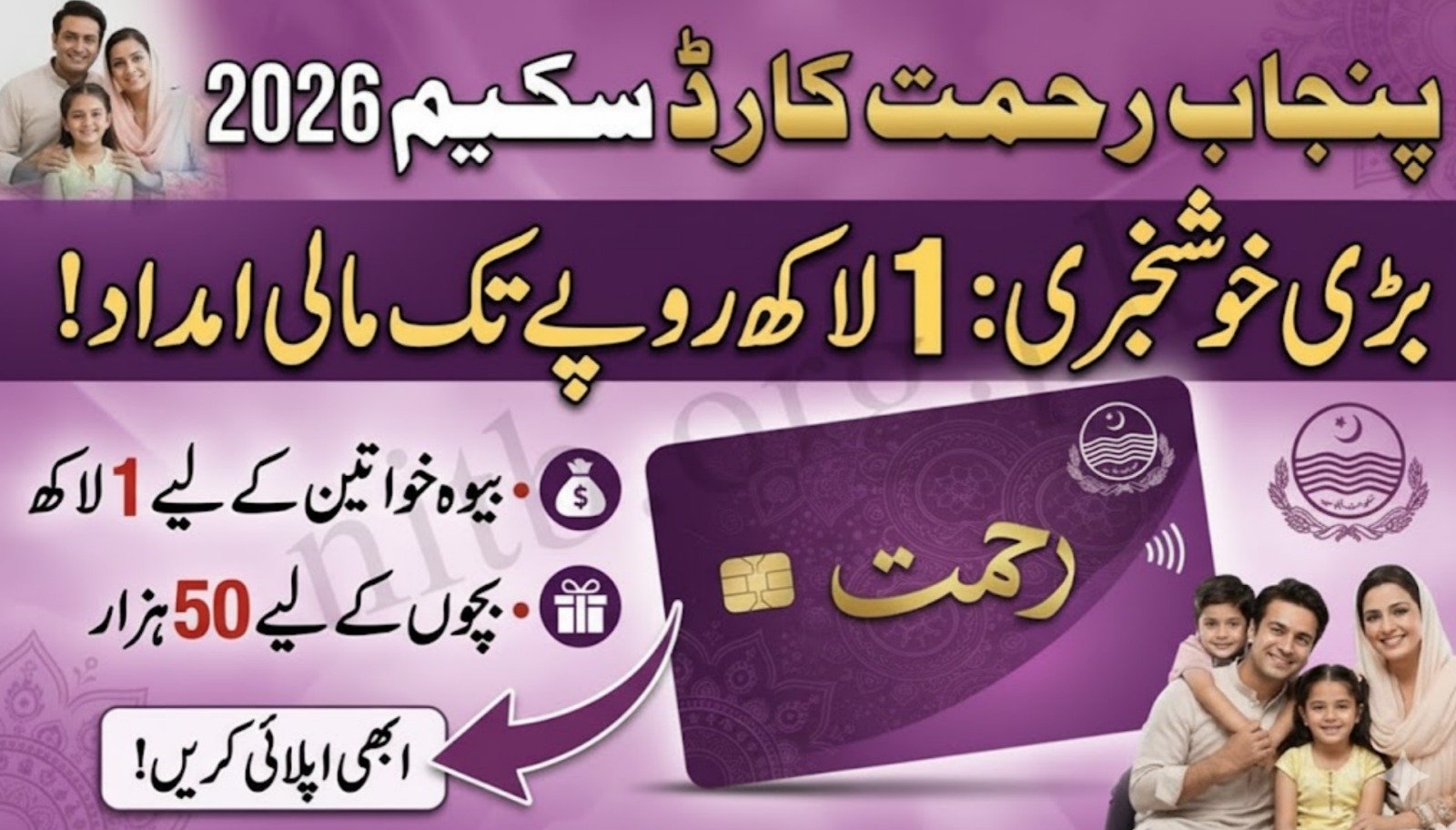
The Chief Minister of Punjab, Maryam Nawaz Sharif, has officially launched the “CM Punjab Rehmat Card,” a landmark social welfare initiative designed to provide financial sovereignty to the most vulnerable segments of society—widows and orphans. This program is not just a standard cash transfer; it is a comprehensive economic empowerment package aimed at lifting thousands of families out of poverty by providing them with the capital needed to start small businesses and secure their children’s educational future.
The Rehmat Card addresses the immediate financial shocks faced by families upon the loss of a breadwinner. By digitizing the disbursement process, the Government of Punjab ensures that the aid reaches the rightful beneficiaries without the interference of middleman or administrative delays. Below is a detailed guide on how to apply, who is eligible, and what benefits are offered under this scheme.
CM Punjab Rehmat Card 2026 Overview
The following table provides a concise summary of the program’s key features for quick reference.
| Feature | Details |
| Program Name | Chief Minister Punjab Rehmat Card |
| Launched By | CM Maryam Nawaz Sharif |
| Primary Beneficiaries | Widows and Orphan Children |
| Financial Aid (Widows) | Rs. 100,000 (One-time Business Grant) |
| Financial Aid (Orphans) | Rs. 25,000 per Child (Educational/Support Grant) |
| Provincial Jurisdiction | Punjab, Pakistan |
| Registration Method | Online Portal & District Zakat/Ushr Offices |
| Official Portal | punjab.gov.pk |
| Verification Authority | NADRA & Punjab Social Protection Authority (PSPA) |
Objectives of the Rehmat Card Scheme
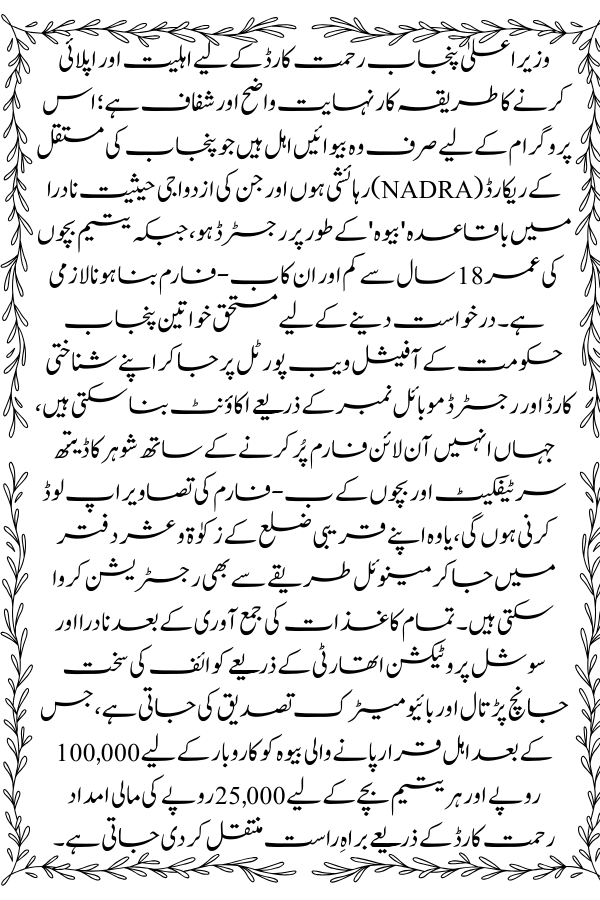
The primary objective of the Rehmat Card is to transform beneficiaries from aid-seekers into self-sufficient citizens. For widows, the grant of Rs. 100,000 is intended as “seed money” or startup capital. Whether it is setting up a small stitching unit, a poultry farm, or a grocery store, this amount provides the necessary push to generate a sustainable income.
For orphans, the grant of Rs. 25,000 per child ensures that their basic needs and educational expenses are met, preventing them from falling into child labor due to financial constraints. The program aligns with the broader vision of a “Digital Punjab,” where welfare is delivered transparently through biometric verification and automated banking systems.
Eligibility Criteria for Applicants
To ensure that the funds are utilized by those in genuine need, the Punjab government has set strict eligibility protocols. Applicants must meet the following conditions:
- Provincial Residency: The applicant must be a permanent resident of Punjab, as evidenced by their CNIC and Domicile.
- Marital Status (Widows): The female applicant must be officially registered as a “Widow” in the NADRA database. If the husband has passed away but the status is not updated, the application will be rejected.
- Orphan Status: Children must be under the age of 18 and must have lost their father. Their relationship and status must be reflected in the NADRA B-Form.
- Poverty Score (PMT): The household must fall within the designated Poverty Means Test (PMT) score range, usually verified through the Benazir Income Support Programme (BISP) or PSPA database.
- Employment Restriction: No member of the immediate family should be a government employee, and the family should not possess significant assets like large landholdings or luxury vehicles.
Required Documentation for Registration
Before initiating the online application, ensure you have the following documents ready in scanned or clear digital format:
- Original CNIC: Of the widow or the legal guardian of the orphans.
- Death Certificate: A NADRA-verified death certificate of the husband/father.
- NADRA B-Form: For all orphan children included in the application.
- Active Mobile Number: The SIM card must be registered in the applicant’s name to receive the OTP and payment notifications.
- Proof of Residence: Such as a utility bill or a domicile certificate.
Step-by-Step Guide to Online Application
The Punjab government has simplified the registration process through a dedicated web portal. Follow these steps to apply:
Step 1: Access the Official Portal
Visit the official Punjab Government website or the dedicated CM Rehmat Card registration portal. Ensure you are using a secure internet connection.
Step 2: Account Creation
Enter your CNIC number and mobile number to register. You will receive a One-Time Password (OTP) via SMS. Enter this code to verify your identity and create your profile.
Step 3: Information Entry
Fill out the digital application form accurately. You will need to provide details regarding your household size, the number of dependent orphans, your current living conditions, and your proposed use for the business grant.
Step 4: Document Upload
Upload clear photos of the required documents (CNIC, B-Form, and Death Certificate). Ensure the text on the documents is legible to avoid rejection during the verification stage.
Step 5: Review and Submit
Double-check all entries for errors. Once submitted, you will receive a tracking ID. You can use this ID to check the status of your application on the same portal.
Offline Registration By Zakat and Ushr Offices
For those who do not have access to the internet or face technical difficulties, the government has designated District Zakat and Ushr Offices across Punjab as registration hubs. You can visit these offices with your original documents. The staff there will assist you in filling out the manual forms and entering your data into the provincial system.
Benefits of the Rehmat Card
The Rehmat Card offers more than just financial relief; it provides a sense of security and dignity. Key benefits include:
- Direct Cash Transfer: Funds are transferred directly to the beneficiary’s bank account or linked Rehmat Card, eliminating the possibility of corruption or bribery.
- Business Opportunity: The Rs. 100,000 grant for widows is a significant amount that can launch a micro-business, providing long-term financial stability.
- Educational Support: The Rs. 25,000 per child helps families keep their children in school, breaking the cycle of poverty through education.
- Biometric Security: The use of biometric verification ensures that the money is collected only by the rightful owner.
Frequently Asked Questions (FAQs)
Q1: Can a widow with three orphan children apply for both grants?
Yes. The widow will receive Rs. 100,000 for herself to start a business, and she will also receive Rs. 25,000 for each of her three children (Rs. 75,000 total for the children). The total amount for the family would be Rs. 175,000.
Q2: What should I do if my husband’s death certificate is not from NADRA?
You must first visit your local Union Council or NADRA office to obtain a computerized death certificate. Manual or old certificates are generally not accepted for this high-security digital program.
Q3: Is there a fee for the Rehmat Card application?
No, the application process is completely free of charge. If anyone asks for money to “process” your application, report them to the Punjab CM Complaint Cell at 0800-02345.
Q4: How long does the verification process take?
Typically, the verification takes 4 to 8 weeks, as the data must be cross-matched with NADRA, PSPA, and the Zakat department records.
Q5: Can divorced women apply for this card?
The current phase of the Rehmat Card specifically targets widows and orphans. However, divorced women in need may be eligible for other PSPA programs like the “Himmat Card.” It is advised to check the portal for specific category updates.
Conclusion
The CM Punjab Rehmat Card 2026 stands as a testament to the provincial government’s commitment to social justice. By targeting the most vulnerable—those who have lost their primary support system—the government is building a more resilient and compassionate Punjab. For those eligible, this is a golden opportunity to secure a better future for their children and achieve financial independence. We encourage all eligible citizens to complete their registration at the earliest to avail themselves of these benefits.